
On Wayfinding
reclaiming cultural heritage from the models

Models have swallowed the internet wholesale, and now are flooding it with semiotic detritus. An urgent question remains: if these LLMs are the palimpsest of the accumulated human writing, how can we repurpose them for flourishing?
LLMs present an epistemic assault on too many fronts to count. From their posing as “alien” intelligences, to the mundane delegation of cognition, to their widespread and obvious affront to cultural heritage, it might be easy to see these machines are pure extraction of human writing labor and, particularly, white collar paper shunting. The economic anxiety they’re inducing today is, well, quite well covered. The press and academia are catching up to documenting and exceeding the early warnings I made about LLM Exposure. When I started this Substack in 2024, they were a curio, and perhaps a promising one and an increasingly widely adopted epistemic thing but their economic and political stakes were largely speculative. Doomers and accelerationists alike have always had their prognoses, but now we’re living through it and the questions I originally sat with, those of semiotics, cultural dynamics, and theorizing the LLM remain, to me anyways, as relevant as ever.
Perhaps the reason you’ve stuck with this substack through the years is that I give you a little theory and a little prototype. I remain committed to experiments at the edge of what theory can offer us, and indeed while the substack has lately been quite dormant, the work has continued unabated.
The Easter Project
William Butler Yeats opens his famous poem “The Second Coming” with:
Turning and turning in the widening gyre
The falcon cannot hear the falconer;
Things fall apart; the centre cannot hold;
Mere anarchy is loosed upon the world,
The blood-dimmed tide is loosed, and everywhere
The ceremony of innocence is drowned;
The best lack all conviction, while the worst
Are full of passionate intensity.
I found myself revisiting a trove of theological questions on Easter (April 5th, 2026) as surely billions were as they celebrated the occasion. It’s confusing. I’m raised Jewish, live in a Jewish-Carribean quarter of Brooklyn, and yet, couldn’t help but find myself meditating on why Peter Thiel obsesses over the Antichrist when he himself is so patently a villain. Does he unironically wish to found a surveillance state to halt the coming of a godless society? I have little appetite to rehash his theories, but it’s notable that just recently he’s been on a sold out tour lecturing on the Antichrist including, reportedly, at the doorstep of the Vatican.
Whatever your eschatological convictions are (or aren’t), you can feel that those of the most powerful—the Christian fundamentalists in the Pentagon, the constant invocations of God in the White House—are shaping policy far more than any commitment to more secular conceptions of human flourishing like, say, human rights! I won’t get into Hegseth’s obvious bloodlust, or Trump’s orientalism, because we are all beholding the wreckage of these convictions are, well, more authentically in alignment with (from my inchoate, Jewish, perspective) the antichrist than any Godless secular drag-promoting leftist. Maybe this is why Yeats speaks to me, today:
The blood-dimmed tide is loosed, and everywhere
The ceremony of innocence is drowned;
The best lack all conviction, while the worst
Are full of passionate intensity.
After years of Palestinian slaughter, truly, who is left innocent? In the invocation that the “ceremony of innocence is drowned”, the ceremonies of planetary governance—the United Nations, perhaps NATO—are patently vestigial. This is more a commonly held opinion within the circles I travel than my own, but this means the temperature for collective governance is, well, cold. “The best lack all convention” is such a funny paradox, because can one really be “the best” while lukewarm on the genocide of 10,000s of children and then still claim the mantle of leadership of the American Left? We saw how that worked in the last presidential election.
But whether you agree with any of these musings or not, my own disagreement with Yeats lies mainly in whether or not the center can hold.
Cartographer! Shred the Map!
I am here to claim, that structurally, it cannot not hold. The Ego, the center of conscious perspective, is the center. The maps, the overview, is a common fallacy of enlightenment-era magnificence and colonial expansionism. Maps are composites of measurements, always (as Borges reminds us) fallible. Tim Ingold pithily puts it “There is no such map.”
Rich, isn’t it? A self-fashioned “concept cartographer” (me) and a “cartographer of care” (also me) would challenge the map’s orthodoxy, and for what replacement exactly?
Yet the ontologies of our time, greyed in and grey, demand it! However desperately we try, the superstructures of our time cannot be mapped, predicted, or controlled. Ground truth? Dynamic, swelling, and now simmering with too much radiant heat. This is a planetary-political claim grounded in listening to the pulse: crumbling glaciers, acidifying oceans, rocket’s flying, and no power center or even human mass seemingly able to intervene. You might say: “the best lack all conviction” yet it seems the lack is more foundational: our ontologies are overripe for something else to ascend.
Maybe Yeats’s second coming, then, isn’t about the second coming of Christ, though he may have thought it was, but rather a second coming of a new ontology that lets us shed classic Enlightenment schools of thought for something more durable and honest. Maybe that’s been the trajectory all along. Revisit the institutions that house cultural heritage across millennia, and we find it lying in wait: the pre-colonial, the subaltern, the question and the answer.
I recently visited my partner’s family in O’ahu, and we talked in abundance about the Polynesians who somehow navigated their canoes by wave and starlight to the Islands. Did they go to the Islands or the Islands go to them? From the map’s perspective, the former, from the wayfinding Polynesian’s canoe, the latter.
Nothing is Final, so Stop Yelling
These impressions aren’t a well-rendered argument, so calm down! They are an associational traversal through my mind, wayfinding through impressions and you, the reader are the canoe drifting along the river of my mind, as it sits in the chair, on this sunny Brooklyn day. Arguments give you pitons which may or may not hold, as you ascend to Great Heights. Wayfinding is supple and silky, like wandering through the forest without a trail.
We’ll never arrive. That’s not the point. The point, if there is one, is simply to linger in this clearing together for a moment of respite.
This is all to say, I decided to rebuild Semioscape.org yesterday on the back of these Big Ideas. Where the first iteration was a “concept cartographer” the second is a “concept wayfinder”.
Variations on Semioscape.org
In July of 2024, I released a “concept cartographer” at semioscape.org. The premise was straight-forward: “an AI-enabled tool designed to map out concepts and their relational landscape.”
It was one of the first React apps I had built, and leaned on LLMs to generate snippets of code. The actual creation of the tool is itself a vague memory, but I think I used an assemblage of whatever was the GPT de jour at the time and some Anthropic model…
The New Semioscape.org
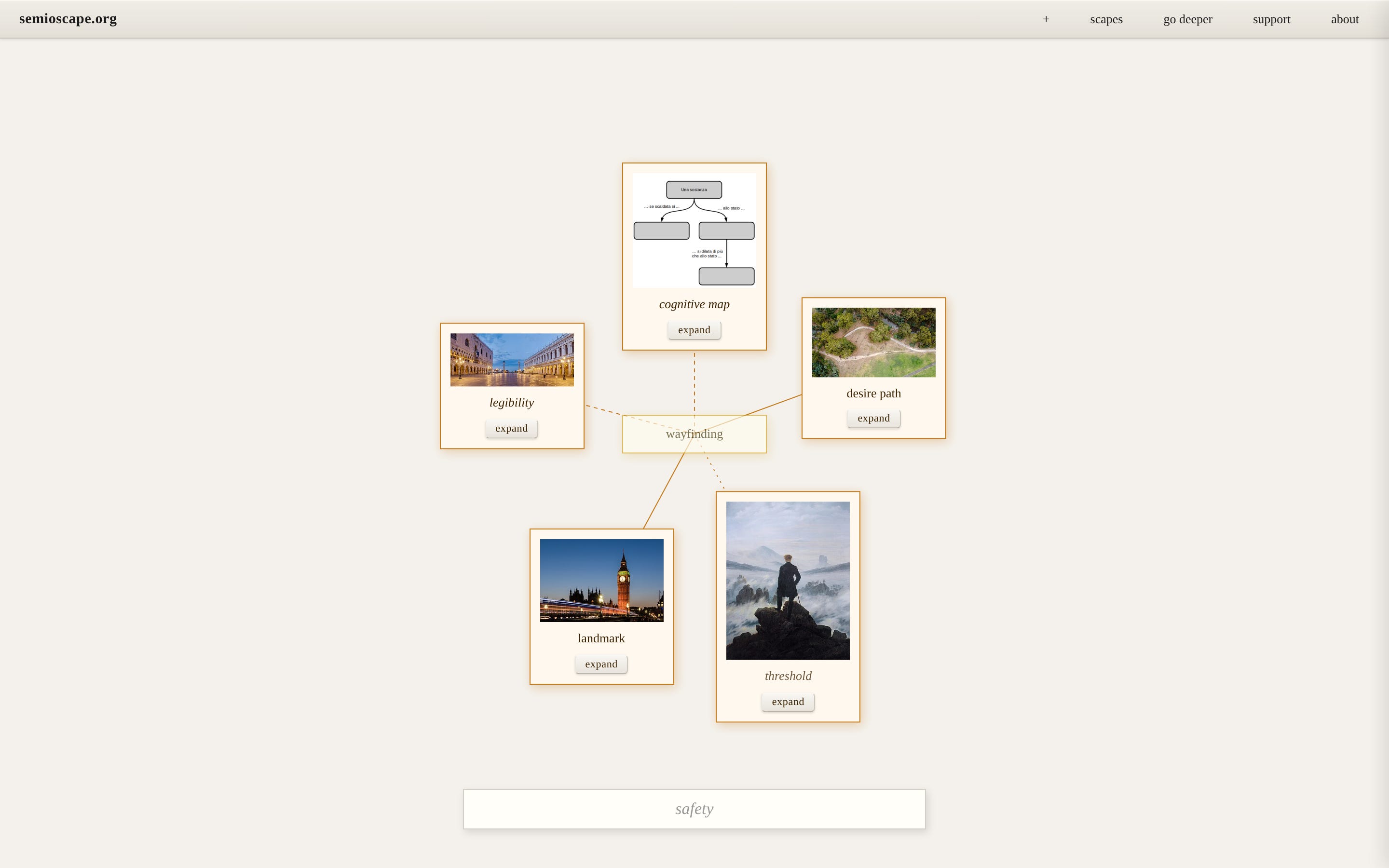
Semioscape.org is an attempt at wayfinding through the model’s inner concept space. It’s productive in the interstice between the model (Claude Haiku) and its human operator. It creates a feedback loop where the human is the wayfinder, the model is the territory, and the interface is the canoe.
Experience it for yourself! Go deep with your own API key. Report back your findings in the comments.
—Blessings
Johan
Postscript! Go for a Wander
it lets you wander through the residue of human culture with an itinerary you didn’t plan
—Claude
I employed Claude Code and Opus-4.6 [1m] to build this. It’s the only model I use these days, unapologetically.
You’ll notice a few key ingredients combine to create a dialectic between parts:
Claude Haiku is the Association Engine and Copywriter
The Wikimedia API serves relevant public domain images
The Interface, built with no libraries but standard HTML, CSS, and JavaScript
I hope you will encounter, as I did, the serendipity, discovery, and delight that characterized the online experiences of my youth.